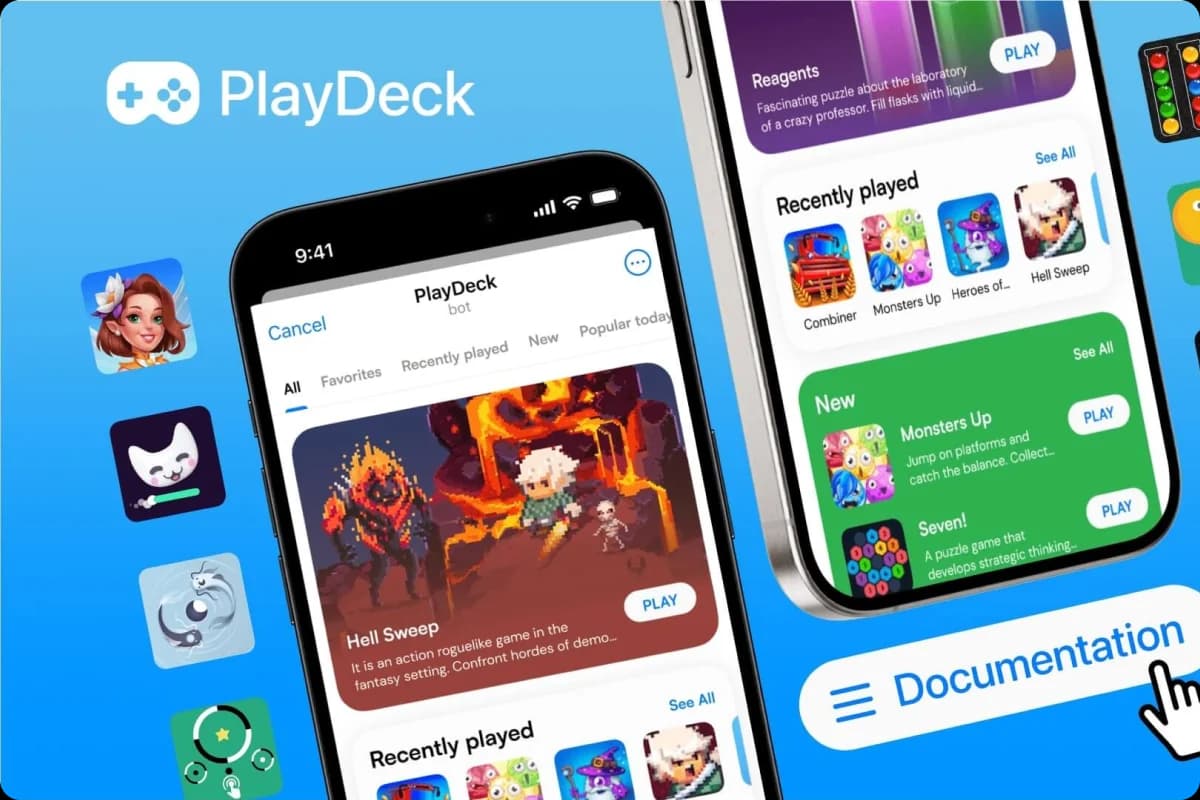
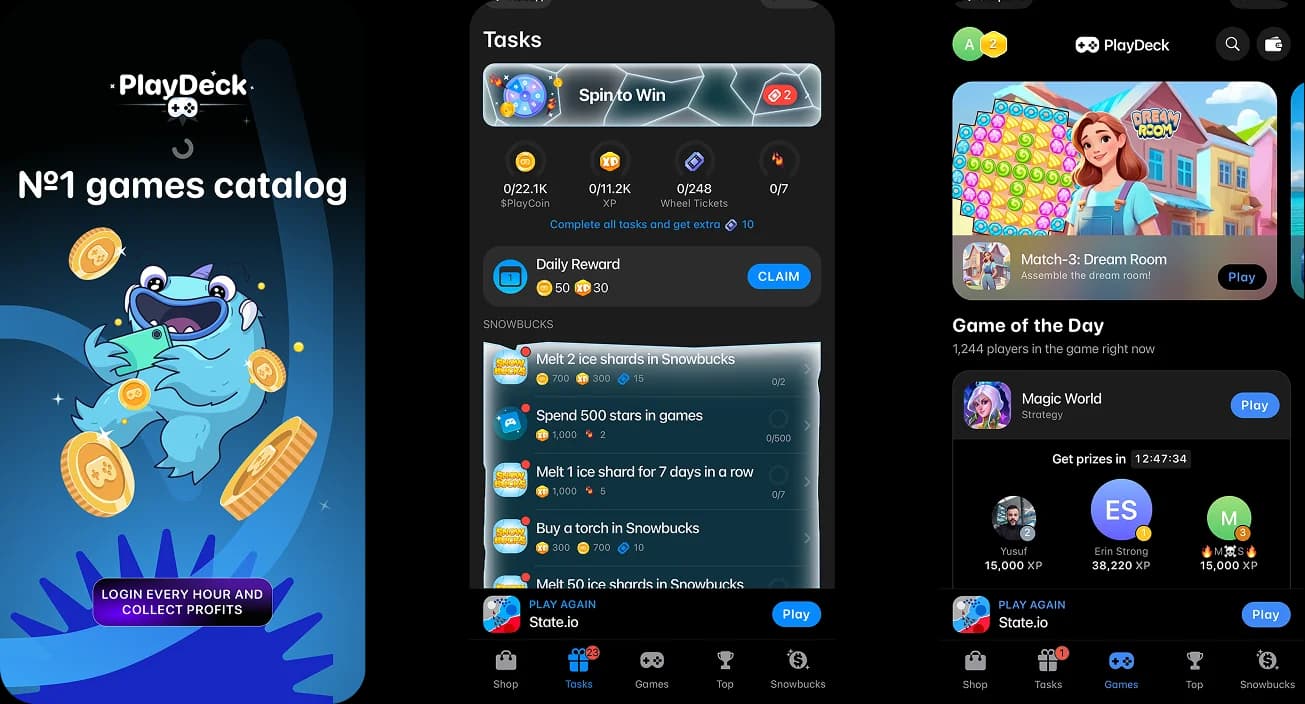
PlayDeck is more than a product catalog — it's the core infrastructure behind Telegram's emerging gaming ecosystem. As the platform's leading directory for mini-games and interactive experiences, PlayDeck connects players, developers, and monetization tools across a highly distributed, real-time environment. When the team behind PlayDeck approached H-Studio, their goal was clear: build a secure, scalable, and modular backend system capable of supporting millions of interactions daily — while deeply integrating with Telegram's ecosystem (bots, Stars tokens, TON payments, and in-chat games).
Our Challenge
Telegram's ecosystem has over 700 million monthly users and a rapidly growing in-chat gaming scene. To support this scale, PlayDeck needed a backend capable of: • Managing thousands of concurrent players in real time • Handling continuous communication between bots, users, and games • Processing payments, achievements, and leaderboard updates within milliseconds • Scaling horizontally without downtime • Offering a developer-facing toolkit that makes onboarding and monetization seamless In short: real-time architecture, zero downtime, and growth-ready scalability.
Our Approach
We designed and implemented PlayDeck's full backend architecture — from system design and data flow to deployment and monitoring — using a microservices-based architecture focused on speed, isolation, and observability. Technology Stack • Backend Core: Kotlin, Spring Framework • Networking: Netty for high-efficiency async I/O • Message Processing: Apache Kafka for event streaming • Databases: PostgreSQL + jOOQ ORM for relational data • Analytics & Storage: ClickHouse for large-scale event analytics • Caching & Queues: Redis for leaderboards, caching, and Redis Streams for delayed jobs • Dev Tools: Docker, Kubernetes, and CI/CD pipelines for continuous delivery System Architecture We structured the platform as independent, domain-specific services: • User Service — authentication, profiles, and session state • Game Catalog Service — indexing, search, and recommendations • Leaderboard Service — real-time ranking and stats aggregation • Payments Service — integration with TON and Telegram Stars • Notification Service — push events, engagement, reminders • Bot Gateway — secure communication layer between Telegram bots and backend Each service runs in an isolated container, with load balancing, centralized logging, and auto-scaling via Kubernetes. Automation & Observability To ensure transparency and reliability, we implemented full observability: • ELK stack and Grafana for real-time monitoring • Slack-based alerting system for critical events • Distributed tracing for debugging and optimization • Continuous delivery pipelines were built to support rapid iteration without downtime. Security & Reliability The architecture was designed with multi-layered security: • Encrypted service-to-service communication • Rate limiting and authentication at API-gateway level • Automated security audits integrated into the CI/CD flow Integration with Telegram One of the most technically complex aspects was deep integration with Telegram's internal ecosystem: • Bot API & Inline Games — instant launch of games directly from chat • TON Payments & Telegram Stars — multi-currency support for in-game purchases • Deep Linking & Referrals — seamless movement between games and user channels • Real-Time Messaging — handling thousands of concurrent bot updates per second This setup enables real-time synchronization between chat activity, game sessions, and backend systems — effectively turning Telegram into a complete gaming platform.
Results
- PlayDeck successfully launched and became the backbone of a fast-growing Telegram gaming ecosystem
- Thousands of games and millions of daily interactions
- Sub-200 ms response time under peak load
- Zero-downtime deployments
- A sustainable foundation for global developer onboarding and in-chat monetization
- The system now powers a global community of developers and players who build, share, and play — all within Telegram
Technical Stack
Backend: Kotlin · Spring Framework
Networking: Netty
Messaging: Apache Kafka
Databases: PostgreSQL + jOOQ ORM
Analytics: ClickHouse
Caching: Redis
Infrastructure: Docker · Kubernetes
Duration: Ongoing
Team: Senior Engineers
Insights
Scalable infrastructure is the foundation of product-market fit: you can't grow what can't handle growth. Observability, modular design, and async messaging (Kafka, Redis Streams) dramatically simplify real-time systems. Startup speed doesn't have to mean technical debt — the right stack makes both possible. PlayDeck proves that even early-stage products can run on enterprise-level architecture without enterprise-level budgets. By combining modular microservices, event streaming, and automation, H-Studio helped create a platform that scales naturally — a perfect example of "Startup Engineering that Lasts."
Relevant Services
Backend Engineering
Enterprise-grade backend systems, scalable APIs, and microservices architecture for high-performance applications.
Learn more →Kubernetes Consulting
Container orchestration, automatic scaling, self-healing, and rolling deployments for resilient microservices.
Learn more →Monitoring & Observability
Full-stack observability with Prometheus, Grafana, and ELK Stack for real-time insights into system health and performance.
Learn more →